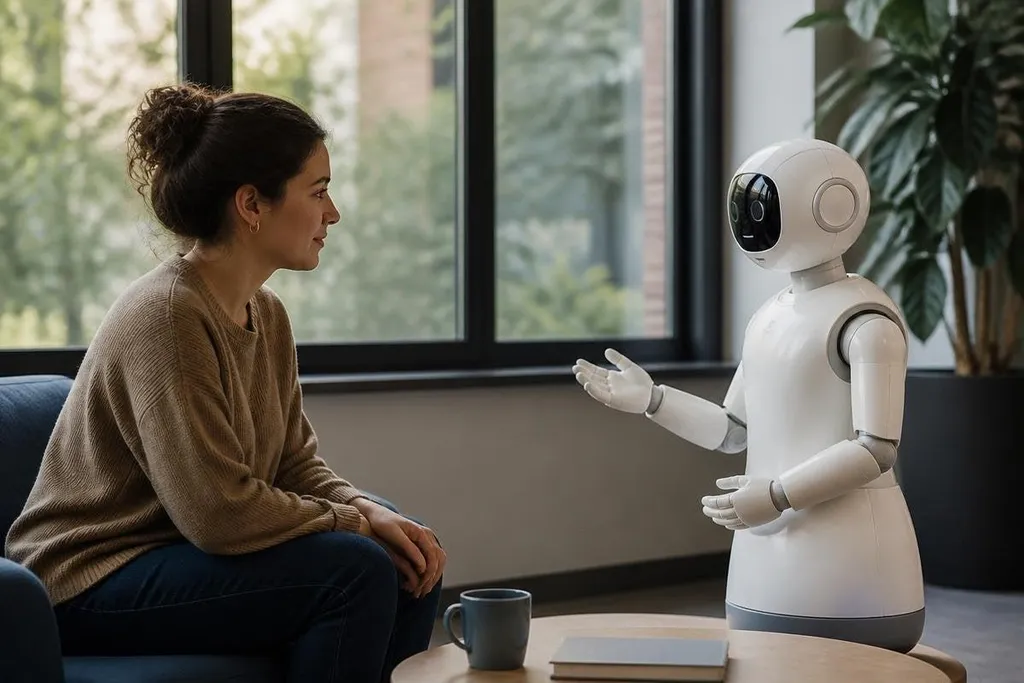
A social robot can change a person’s actions through its voice, timing, movement, and use of attention. The hard part is proving when that change helps people and when it merely makes a machine seem more believable.
- Signals matter: gaze, pauses, gestures, and distance can shape how people respond.
- Setting changes the result: a school, hospital, home, and workplace create different pressures.
- Evidence needs care: short trials may show a response without showing lasting behavior change.
The signals a robot sends
People read meaning into a robot’s behavior even when they know it has no feelings. A head turn can suggest attention. A pause can signal that a reply is expected.
A voice with a warm tone can make an instruction feel less severe than the same words spoken without that tone. These signals can guide a person’s next action, but the effect depends on timing, task design, and the person’s reason for using the system.
Facing a user while giving a safety instruction may help direct attention to the instruction. Repeating a prompt after a missed step may support a routine.
Movement matters too. Moving closer may ask for attention, but the same action could feel intrusive in a private setting. Designers need to set clear limits for speed, distance, and when the robot may move without a direct command.
Why people may follow a robot
A robot can influence behavior through several paths. It may give a clear prompt, make a task feel social, or show what action should happen next.
Feedback may also be easier to notice because the message arrives through a voice, screen, light, or gesture in the same place as the task. That influence can support useful routines.
In a training setting, the robot could ask a learner to repeat a step. In a care setting, it could remind someone about a scheduled task. During an approved drill in a public space, it could direct people toward an exit. These are possible uses, not proof that people will follow every prompt.
The risk is misplaced trust. A person may treat a confident voice or human-like face as evidence that the robot understands more than it does. That can lead to poor choices when the system misses a changed situation, gives an unclear instruction, or cannot explain its decision.
A short trial may show trust rising while repeated mistakes remain unseen. Social robot reporting from Robot24.com can link that result to the model, trial length, and test setting before the next section looks at effects that take longer to appear.
Short trials can hide long effects
A person may follow a robot during a test because the task is new, a researcher is nearby, or the instructions are easy to see. That response does not show that the same behavior will continue after repeated use. It also does not show if the person learned the task or became dependent on the robot’s prompts.
Good testing needs more than a single response. It should record what the person did before the robot arrived, what changed during use, and what happened after the robot stopped giving prompts. The test should also record failures, refusals, confusion, and cases where people followed a wrong instruction.
The setting must stay visible in the results. A robot that gains attention in a quiet room may behave differently in a busy workplace. A child may respond to a robot in a classroom because a teacher set rules for the activity. An adult using a robot alone may have a different reason to comply.
Design checks before deployment
A team deciding if a social robot should influence behavior can check these points:
- Name the target behavior: write the exact action the robot should support, such as checking a label or starting a task.
- Set the robot’s limits: define where it may move, when it may speak, and which commands need human approval.
- Test mistaken trust: give the system a case it cannot handle and record how people respond.
- Measure after removal: check if the behavior continues when the robot stops prompting.
- Include refusal: let people ignore or silence the robot without losing access to the service.
- Review the setting: repeat the test with the noise, pace, and social pressure of the place where the robot will work.
I’d treat a social robot as a behavior tool, not as a substitute for clear rules or human judgment. Its voice and movement may guide action, but they cannot prove that the guidance is correct.
The open question is measurable: after the robot leaves, does the person still perform the task safely, or did the behavior leave with the prompts?